Monday, May 26, 2014

House Hunters: Milestone One!

Emily and I have finally purchased our first property!  I am sorry that it took so long to write this entry but there were many factors involved, and buying property in Ecuador isn't as always as easy as it might appear.


The Property

The purpose of this blog entry is to describe the property that we bought.  If you read the previous blog entry, it's Property Three.  It's a pair of adjacent lots in a small fishing village called Machalilla, about ten minutes north of Puerto Lopez, located here:  https://maps.google.com/?q=-1.470212,-80.764795

If the link doesn't work for you, here's the satellite view from Google Maps:


The two lots, enclosed inside a brick wall, are 20m x 20m each (about 66 feet), with 40m (131 feet) of beach front at an elevation about 20 feet above the high tide mark.


The Boundaries

West: - The beach:  It is currently covered in shrubs and debris with a sprinkling of chickens and pigs.  It has been neglected for a very pragmatic reason: Machalilla is a functioning fishing village, and the locals lean toward getting work done as opposed to encouraging tourism or foreign visitors.

There is an access road in front of our property for our three neighbors to the north.  It was recently fortified with 2" rock gravel and graded to create a solid road surface with anticipation of the upcoming El Nino.

The area between the access road and the beach is approximately 50m deep.  In the 2008 Ecuadorian Constitution, President Correa decreed that all undeveloped beach front land within 50m of high tide is public land.  In front of our property, there are no structures; only brush.  All beaches in Ecuador are public, so we cannot restrict access to it (nor would we want to), but nothing permanent can be developed there either.

To the south and west of our lot is a covering (four posts and a roof, the square grey roof next to the road) where a fisherman's assistant spends his days.  He helps the local fisherman by repairing nets, selling bait, etc.  The person that tried to build a structure there was told by the comuna that his structure was not allowed, and further development was abandoned.  The "helper" decided to set up shop there, and he's an institution now.  (He's also the one that helped us find the owner of the property that we bought.)

North - the farm:  Our neighbor to the north raises free-range chickens and pigs (driving is a cautious process to avoid the little chicks running around and the hens chasing them).  From what I can tell from my conversations with them (remember, my Coastal Spanish still needs a lot of work!), they own their house and the beach property in front of them.  On appearances, they seem to be friendly people, and I look forward to getting to knowing them.

East - the cemetery: The right-side border to our property is a very large cemetery; it runs from the edge of our property for about 150 meters.  I know that this might be disconcerting to some people (meaning US and European citizens), but it's actually a very good thing to have here in Ecuador.  Cemeteries are very hallowed ground here, and no one (regardless of age or intent) would think of crossing a cemetery to commit a crime.  For us, it's like having a built-in guard along our entire eastern border.

South - neighbors and hostel:  I don't know anything about our immediate neighbors to the south.  I'm sure that they are just local citizens; I just haven't met them yet.  The property beyond them is a hostel that, to say it kindly, could use some repairs.  They are interested in selling the place and are holding out for a price of $500,000!  It might be worth a tenth of that; I think they'll be waiting for quite a while.


Property Usage

The ground itself is completely undeveloped and currently covered with grass and brush.  Machalilla has city water, so we will be able to bring utilities from town to the property.

As I mentioned above, these are two adjacent lots of equal size.  We had thought about developing them as a single property but instead have arrived at a different conclusion.

Machalilla is a beautiful town, but it isn't the final destination for us.  (More on that in a later post.)  This is the approach we are going to take with this property:

  • Keep the lots separate.  They each have a separate escritura (title), and there is no reason to get the property redeeded (is that a word?) into a single lot.
  • Find a rental property that is closer to the lots we own.  Our current rental is a fantastic place in San Jose and our hosts have been wonderful, but we're currently a hour away from Machalilla.
  • Survey the lot.  We need to know the exact back boundary to build a retaining wall against the cemetery.
  • Bring utilities to the property.  Each lot will need it's own electric pole, transformer and meter as well as separate water lines and meters.  They will also have separate septic systems; sewer systems in Ecuador are only common in very large cities (e.g. Manta, Guayaquil).
  • Since we're going to develop the lots as separate properties, we're going to first develop one for ourselves.  Once it's complete (and this should take 4-6 months), we'll move into it while the other lot is developed.
  • Develop the second lot as either a rental property or for sale.
  • We are currently in negotiations for our "final destination" property.  If we successfully close on it, we'll start developing it once we have completed  the Machalilla development.

 
Pictures

For anyone who has made it to the end of this post, I've added some pictures of the lot and surrounding area.  Up to our final close, we have avoided being conspicuous and have limited our visits.  There will certainly be more pictures to come!

View of the beach looking south toward Machalilla:


View from our lots towards the beach (we're going to host a brush cutting party someday - I'll bring the beer and machetes!):


Looking at the lot through the fence (with the cemetery in the background):


The seller lives in Guayaquil, but his father lives in Machalilla.  We need to visit him to get the key to the gate lock.  Yes, I could use a bolt cutter to open the gate, but I'd rather return his property to him in functioning condition.

To avoid overreaching in this blog post, I'm going to detail the purchase process in my next blog post later this week (unless something more dramatic happens first!).

Thursday, March 27, 2014

House Hunters: Episode Three

As I sat down to write this, I realized that it's been over four months since I wrote anything about our property search!  I apologize for the delay; we've been learning a lot about the acquisition process and what it takes to own a home here.  There's a lot to learn!

Emily and I are continuing our search for a place of our own.  Since our arrival in Ecuador, we have looked at over one hundred lots and structures, trying to determine what we like, where we want to live and what accommodations we want to have.  We've determined that these are some of the characteristics of the property that we want to own:

  • Property on the ocean front
  • A three bedroom house for ourselves
  • A smaller one-bedroom house (una casita) for guests/rentals
  • Small-town location
  • A workshop for gardening and other projects
  • A pool

Of the properties that we've visited, about a half-a-dozen met those parameters.  The ones that qualify are too expensive; the ones that don't qualify are either not in a desirable location or will require too many repairs to justify.  As a result, we've decided to purchase property (either with structures or without) and build to our own vision.  Having said that...


Stand by for news!


We currently have offers extended on three different properties.  They are all within 45 minutes of Puerto Lopez (https://maps.google.com/?ll=-1.560037,-80.805917), both north and south.  All three are empty lots with enough space to do what we want.  However, each of the three illustrates a different challenge in purchasing property here.

Before getting into more detail about the properties, there are a couple of background items to discuss.


Measurements

All measurements here, of course, are metric.  (I now even own a metric measuring tape!)  Land area is specified in square meters (or hectares - 10,000 square meters per hectare for large parcels).  Here are some guidelines for converting metric measurements to standard:

  • This blogging tool doesn't do superscripts, so I'll represent a square meter as "m2".
  • 1 m2 = 10.8 square feet
  • 1 acre = 4047 m2
  • 1 acre = 43,560 square feet
  • A typical suburban lot in the US is about 8000 square feet (roughly 1/5 of an acre) or about 800 m2


Property Ownership

Since we are not interested in a condominium or living in a gated community, I don't know the parameters of ownership in those situations.  For individual lots, there are two types of property ownership: comuna and escritura (titled).

Comuna land, as the name implies, is land that is owned by a community, and the owner of the lot is determined by the comuna leadership (both residential or commercial).  In most cases, a family has been on a given lot for years and has built a house or other structure, but they do not own the land.  The comuna has granted a "right-of-usage" to the family that can be revoked at any time, although this is extremely rare.  Purchasing right-of-usage on comuna land, especially for ex-pats, is not recommended.

(It is possible to convert comuna land to private ownership, but that's a topic for another day.)

Property that has an "escritura" has a private title and a specific ownership group.  This deed, the associated property tax records and the registration with the canton are necessary for a complete transfer of ownership to another private property.  These are the only properties that we are considering.


Inheritance

This next section may sound a little weird (it certainly is to me!), but it is how I understand the law to be here.

When property is purchased by an individual or a company, they are the sole owners of the land.  When it is purchased by a married person, however, it is automatically owned evenly by both spouses.  So far, so good.

When one spouse dies, however, the surviving spouse continues to own 50% while the other 50% is distributed evenly among the children.  The surviving spouse retains a "right-of-usage" on the children's ownership shares (the children can't evict the parent, say), but the property ownership cannot be changed/transferred without the agreement of all parties.  Once the surviving spouse passes, full ownership is distributed evenly among all surviving children.

(Without going into too much detail, it gets even stranger if there are no children.  Ownership transfers first to the surviving parents if they are alive; otherwise, it will go to the siblings of the spouse that died.  If there are no surviving siblings, it goes to nieces and nephews.  It gets pretty arcane; it seems like a goat might eventually own the land.)

The premise of these laws is founded in the comuna community and is intended to ensure that the property stays in the family and that a person will always have a place to live.  The intention is noble and good, but (in my opinion) does not transfer well to today's global economy and is a challenge that is being addressed by a country that is modernizing.

What about a will?  It doesn't matter.  A will (such as we have in the United States) does not apply here; the law of inheritance supersedes the wishes of the owner.

The only way around this practice is to have the property owned by a company.  In this situation, the directors of the company determine what happens with the property and how ownership is determined.  If the company sells the property to a private party, however, it's back to step A.  Once we purchase property, Emily and I are planning to form a company to control ownership of the land.  (We've started businesses and corporations before.  It will be just another challenge of living here!)

(Remember the Manglaralto white house from a previous post?  That's a direct result of this scenario.)


And now, the rest of the story...


At the top, I mentioned that we had made offers on three properties.  They are all still viable, but they are going in three different directions.

Property One:

This is a 1800 m2 lot with 50m of beach front north of Puerto Lopez.  It consists of two sections (beach front and back lot) with a road dividing them.  The owner is willing to sell them separately but will drop the price 30% if they are sold as a unit.  We made a verbal offer to buy the package.

A background check of the previous owners created a red flag, however.  Two or three owners prior, someone had made a claim to the back lot.  We were told that the claim had been settled verbally (insert Pinocchio's nose here) and that the title was clear.  This purchase is on hold until the claim is fully resolved and a clear escritura is available.

Property Two:

This one is a smaller lot (about 750 m2) in the middle of a very charming small town south of Puerto Lopez.  There is a malecon (road) between the lot and the beach, but nothing can be developed in front of it.  Our intention is to buy and hold this lot for future use.

With this property, however, the inheritance law is getting in the way.  The lot is currently owned by a woman and her four children.  They all want to sell, but they can't agree on the price.  The woman and three of the children want to sell for X; the fourth child wants to sell for X times 2.  Until they can agree, the sale can't move forward.


Property Three:

This is a 800 m2 property north of Puerto Lopez with 40m of beach front.  Finding the owner of the property was a challenge, however.  The agent that we've been working with was spectacular in getting this information.

Just down the street from this lot is an elderly man who helps the local fishermen: selling supplies, fixing nets, etc.  When our agent asked him if he knew who owned the property, he said that he wasn't sure but that we should ask at the blue house just past the second park going into town.  (Yes, this one of those "turn-left-where-the-big-oak-tree-used-to-be" scenarios.) 

Forty-five minutes later, we found the blue house.  Our agent went in and asked about the property.  They didn't know the owner, but they had a calendar from his business with a phone number at the bottom.  A call to that number determined that he was in Guayaquil (four hours away) but that his wife was in town and that she had all of the paperwork.  Her house was, "at the top of the hill, behind the park that's next to the church".  (That's not verbatim, of course.  There are no contractions in Spanish.)

We found the church and our agent set off on foot.  A half hour later, we heard the good news.

The escritura, tax records and registrations were all in order.  He hadn't really considered selling the lot, but if someone gave him X, he would take it.  Our agent made a counteroffer, and it was verbally accepted.

Earlier this week, we returned to get the paperwork.  We have forwarded this information to our attorney for review, and we are optimistic about the sale happening.  (I should probably say, "cautiously optomistic".  Nothing's over 'till it's over.)


Selling our house in the States was so much easier than this.  Pick an agent, search MLS, have an open house and choose an offer; the next thing you know, you're in escrow!  I guess it's just part of the fun and learning experience of living in a rapidly developing country.  Hopefully my next entry will be describing the actual sale and title transfer!


Scott in Ecuador...

Good Day!


Tuesday, March 11, 2014

Crash into me...


Life in Ecuador has much in common with life anywhere.  We shop for groceries, we pay the electric bill, etc.  We also get into traffic accidents.

This might be an example of karma striking back.  Shortly after I wrote the blog on driving in Ecuador and my skills in incident avoidance, we were in our first traffic accident.  It was a rear-ending and completely out of my control.  Just saying...

Accidents happen here like anywhere; how they are resolved here is, of course, "foreign".  It's the resolution that's prompted the delay in this post.

Emily and I were going to La Libertad for our semi-monthly grocery run.  La Libertad is about an hour and a half away, depending on traffic, so this is a special event.  We try to buy most of our food locally; however, items such as dish soap, jumbo packs of TP and bacon are much easier to get at one of the larger supermarkets.  La Libertad has three such stores: Super Aki, SuperMaxi and Mi Comisariato.  The El Paseo mall (where Mi Comisariato is found) also has a movie theater and other shops that can't be found locally.

As is common around here, we told the other expats that we were going to be making the trip and asked if anyone needed supplies.  One of our friends said that he also had some shopping to do and asked to ride along.  (Since he was with us when we were rear-ended, he asked that I not mention him by name.  Therefore, in this entry I will refer to He-Who-Shall-Not-Be-Named as "Tom Marvolo", or "Tom" for short.)

We had just finished our shopping at El Paseo and were on our way out of La Libertad.  The main street in La Libertad, Ave Doceava, is a free-for-all with traffic alternately expanding from two lanes to four, contracting again, and miscellaneous (and unannounced) repairs occurring at random.  The road is shared by street vendors, dump trucks and tuk-tuks.

We were stopped at a red light with cars in front of us when we were hit.  Always trying to be aware of my surroundings, I saw the vehicles approaching and Emily also saw the collision coming from the side mirror.  Fortunately, Tom (riding in back) had raised his headrest at the mall.  Seeing the impending impact, I locked the brakes on our car and no one was hurt.

As best as we can reconstruct, the taxi stopped extremely quickly behind us, but did not hit us:


until, a split-second later, a Chevy SUV hit him:


(Fortunately, although the taxi driver did complain of a sore neck, no one was seriously hurt.)

In the on-coming traffic lane, a Transito had seen the whole thing unfold.  Between him and his partner who had been monitoring the corner (that's him in the upper-right of the picture), all of the vehicles were pulled to the side of the road to assess damage.  What happened next is where things start to go weird.

While the Transitos were discussing what happened and trying to recreate the accident, the female passenger in the white SUV approached us and said that it was our fault; we had stopped suddenly for a green light and caused the accident.  (Unfortunately, we didn't have DashCam going at the time.  We're religious about it now.)  She was visiting Ecuador and the driver of the white SUV was taking her to Guayaquil.  She spoke English; the driver did not.

My reflex, as one would do in the States, was to approach the driver of the white SUV, exchange information and let the insurance companies resolve the issue.  When I tried to offer him my contact card, though, he backed away before reluctantly taking it.  He offered no information in return.

Our damage, by the way, was minimal.  We would need a new bumper and some minor repairs:


In Ecuador, the person that hires a driver is responsible for the driver's actions and the consequences of his actions.  The female passenger was furious that she might be responsible for this accident and wanted it to just go away.

She approached me and said that if we couldn't resolve this right now that we would all go to jail until a court could resolve it in the coming days.  My reply: "That's okay - I've got time."  She didn't like that.  She then went to Tom with the same plea.  Tom's response: "I've been to an Ecuadorian prison; they're not that bad."  (Full disclosure here: Tom has been to an Ecuadorian jail but just as a visitor; he has never had to serve time for an offense.)

After some discussion, the Transitos had determined that the white SUV was at fault.  Tom called his attorney to act as a translator between us and the Transitos.  They told us that we were free to leave but we would need to stay around if we wanted any compensation from the female passenger.  We said that we did.  The Transitos decided that it would be best to get off of the main street, so our little parade of the Transito pickup and three vehicles headed to the local police station:


It was here that we negotiated a final settlement.  The woman, wanting to get to Guayaquil, settled with both us and the taxi driver.  (Again, Tom's attorney was invaluable in this process.  As Will Smith once famously said, "I have got to get me one of these!")  The taxi driver had received the majority of the damage and received 80% of the money that the woman had on her; we received the other 20%.  There were no claims to the other vehicle's insurance company and no written police report.  We all went on our way.

A couple of days later, we brought our car to the Chevy dealer in La Libertad (http://www.automotorescontinental.com.ec/).  (Also, I have since found a different route through town and no longer drive on Ave Doceava.)  Alvaro, the dealership manager, was someone who we had met before, and he could not have been more helpful.  They wrote up the report for our insurance company, filed the claim, and, once it was approved, completed all of the repairs.  Between our deductible and the cash that we received from the female passenger, we were out about $80 for repairs and $6 for a couple of long bus rides.

The car is as good as new.  We're back on the road, developing another House Hunters episode.

Sunday, January 26, 2014

Tenemos agua caliente! Dia feliz!

We have hot water!  A new water heater was installed and we now have running hot water to the shower and kitchen sink.

A little context is in order first.  Although people in the States take items like hot water, insulation and air conditioning for granted, most houses built in Ecuador do not have these.  For rural Ecuadorians, a house is basically a shelter from the wind and rain and a place to call home.  Houses that Gringos live in are generally either built from scratch or retrofitted to include the "creature comforts" that we're used to having.

If you've read my earlier blog entries, you're familiar with the electric "suicide shower" head that creates hot water for showers.  I turned it on last week to take a shower and it suddenly had a bright orange glow inside.  Not wanting to tempt fate, I turned off the breaker to the shower head and continued with a cool shower.  (The wiring to the shower head was impeccable; the shower head itself had failed.)  I told our hosts about it, and they immediately decided that installing a water heater was in order.

This is where the retrofitting comes in.  This is the layout of the first floor of our casita:


(Please forgive the crudity of the drawing.  MS Word is the only decent drawing tool that I have at the moment.)

The goal was to bring hot water to the kitchen sink (the dual ovals at the bottom) and the shower (that explosion-looking icon in the middle).  With the water heater mounted on the side of the house next to the utility closet, here is how the water lines would run:


The water heater is an on-demand, gas-fueled unit, so it doesn't require electrical service; batteries provide the ignition, there is no tank for storing hot water and a propane tank provides the gas.  It does require venting, however, so it will be installed outside under one of the eaves.

First step: run the water lines.  Running the pipes around the exterior was easy enough:

(water line to the shower)


(water line to the kitchen)


The interior required much more effort, especially for the shower.  The stairs were removed (two lag screws - no biggie), the old shower faucet was chiseled out and a channel for the new pipe was chiseled in:


The new faucet was installed with a little creativity to keep the hot on the right faucet:


All of the connections were made.  Time to mud it back up and reinstall the stairs.  Once it's painted, you'll never know it was there:


Last step - connect the water heater:


Sorry - one more step.  We need new faucets, the kind that have two handles on them:


The whole process took about two days, and we couldn't be happier with the results.  Oh, happy day indeed!

Thursday, January 16, 2014

Driving in Ecuador

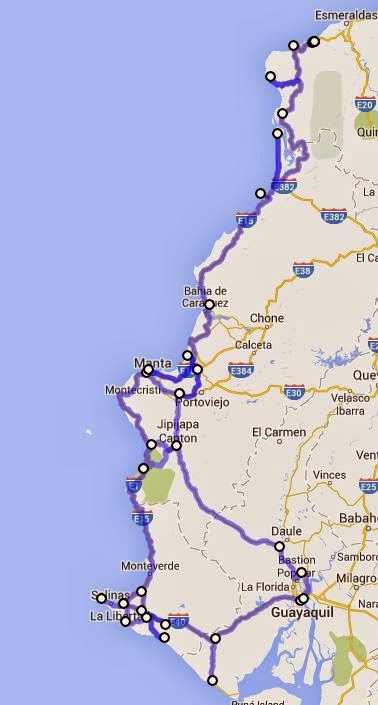
In the course of looking at properties in Ecuador, we have driven over 7500 km in the last 3+ months.  As best as I can represent with Google Maps, here are the places that we've been:


(By the way, all units are metric here. For reference, 100 km is about 62 miles standard/imperial.)

Driving 7500 km (4700 miles) might not seem like much in that time span.  Considering that the northern most point on the map (Atacames) and the southern most (Playas) are about 600 km apart, it adds up to a lot of road trips.

The roads here can hold a lot of surprises, and I recommend driving here only for people with experience and good driving skills.  In addition to having taken formal driving classes on accident avoidance and adverse road conditions (and having grown up in the snow and ice of the Upper Midwest!), I've logged over 500,000 miles of experience.  Here are some of the road trips that I've made in the States:


(I've also received tips and pointers from my brother, a formally trained Highway Patrol officer.  Thanks, bro!)

Driving with a partner is very beneficial.  While I focus on the road, Emily handles all of the navigation, climate and entertainment aspects of our ride.  We use a Garmin for navigation (Emily is a Garmin wizard!) and download podcasts of sports-talk radio shows for entertainment.  (Emily also checks for traffic coming towards the passenger side of our vehicle; in the videos, you might hear her say, "Clear", at times.)


Also helpful in navigating around smaller towns are evacuation maps.  Every coastal city has a map showing the evacuation routes and meeting points in case of tsunami:


The Roads

Thanks to massive infrastructure improvements, the main roads here are very good.  Most of the coastal roads are two lanes (even if they do have an "interstate" designation) with shoulders and curbs.  Here's a YouTube look at the drive from our place to Patacon Pisa'o, our favorite restaurant in Puerto Lopez (42 minutes):

http://www.youtube.com/watch?v=IQXB7-NxhJY

Some of the less traveled roads, however, can be a challenge.  This is our drive from Galera to San Francisco.  The sign looked promising:


The road starts out paved and leveled, but it slowly deteriorates to a two-rut track.  If nothing else, check out the "rustic" suspension bridge at the 46:30 mark (55 minutes):

http://www.youtube.com/watch?v=XvzTInav1Bo

Driving in the cities seems to be more of a free-for-all.  Right-of-way should be determined by traffic control but is more frequently determined by the size or type of vehicle.  Here's what I've observed in the right-of-way hierarchy:


  1. Military vehicles
  2. Heavy equipment
  3. Semi trailers
  4. MetroVia buses
  5. Inter-provincial buses
  6. Local buses
  7. Taxis
  8. Passenger cars
  9. Tuk-tuks (tricicletas - I know, this isn't Thailand, but that's what I call them)
  10. Motorcycles
  11. Push carts
  12. Our car
  13. Pedestrians

Here's a clip showing the drive into and through Pedernales.  The first minute or so shows a detour around a bridge being rebuilt before entering the city.  The "Hand of God" shots are actually Emily reaching forward to adjust the Garmin (5 minutes):

http://www.youtube.com/watch?v=a8og8VZZmJE


Obstacles

Besides the condition of the road itself, being aware of what's on the road is critical.  Not only are the roads used to transport people and goods, they are very commonly used for community functions as well.  Some of the obstacles that I've seen that required slowing down, stopping or detouring include:


  • People
  • Dogs
  • Cats
  • Snakes
  • Dogs
  • Horses
  • Mules
  • Cows (all kinds)
  • Goats
  • Pigs
  • Dogs (always dogs!)
  • Chickens
  • Vultures (because, sadly, many of the other animals get hit by cars)
  • A tarantula (no picture - sorry - but it was a six-inch black beauty of a spider!)
  • Construction 
  • Parades
  • Political rallies
  • Tanks and military personnel carriers
  • Birthday parties
  • Marching band practice
  • Heavy machinery


Traffic Control

Many busy intersections will have a "Transito" (traffic officer) stationed at them.  They do occasionally assist with traffic control (when necessary).

We got stopped at a military checkpoint outside of Crucita one day.  We showed them our papers for the vehicle (insurance, SOAT, etc.), but they were mostly interested in the matricula (title) for the vehicle.  They spoke only in Spanish to us for about five minutes (and we tried as best as we could to respond) before one of them stated, "They speak English!".  At that point, the leader of the trio stated, "We're Marines!", and they all stood up straight and proud in their uniforms.  After that, they went back to speaking Spanish for a couple of minutes before sending us on our way.

Along the major highways there are radar guns posted that will tell the driver the speed of the vehicle and flash if the speed exceeds the limit.  These are useful but not always consistent.  Many times, the radar sign will be posted without any speed limit posting; other times, they're just confusing.  Entering Montañita from the north is this short stretch: 50 kph sign, radar sign enforcing 50 kph and another sign immediately following displaying 70 kph:


The highway that we drive most frequently, E15, connects the beach towns along the coast.  When approaching a town, there are sometimes three sets of (very annoying!) rumble strips to warn the driver:

 !

If the strips do not go all of the way across the road, drivers will adjust to have only one side of the car go over the strips: either moving toward the shoulder or aligning the driver's side with the center line.  I've seen this result in games of chicken to see which approaching driver gets to use the clear middle area.  (Ironically, rumble strips have less impact the faster one drives.)

The most effective form of speed control are speed humps:


These require slowing down to 20 kph and everyone obeys them.  Most of them are well marked, but woe to the inattentive driver who discovers an unmarked one the hard way!


Communication

Horns are used very effectively to communicate.  A couple of quick hits will indicate that someone is passing or to say, "Thanks!".  Horns are rarely used to express irritation (unlike in the States where that seems to be their sole purpose).

Flashing one's headlights is done for two reasons:

  • As self-defense: if a bus is passing a car that has moved over to avoid hitting a goat, a quick flash of the lights will warn the bus that they're approaching oncoming traffic.  (Then again, if it's a bus, see the right-of-way hierarchy above.)
  • As a warning: if a single car flashes it's lights, it usually an indication that there is a pack of mules around the next curve.


Driving at night

Don't.  Even if you know the road you're driving, you might not see that black bull standing in the middle of the road until it's too late.  I heard a guy early one morning swerve late to avoid a parked car and he rolled his truck into the cemetery next door to our casita.  Fortunately, both he and his girlfriend were unhurt:


That's enough for this post.  Time to ride off into the sunset...


Thursday, January 2, 2014

Chicken feet

This is a real quick, kiss-and-cry kind of post.

Emily and I (mostly Emily) roasted a store-bought chicken today.  Since it was a shrink-wrapped "Mr. Pollo" chicken, we expected it would be like chickens in the States.  For the most part it was, but there were two differences.

First, the neck was still attached.  Emily pulled and pulled on it thinking it was like a Thanksgiving turkey where the neck is inserted into the upper cavity.  Nope - it was still a part of the chicken.

Second, there was a pouch inside the cavity with the gizzards and other internal parts (just like a turkey).  But there was a surprise I didn't expect to see:


This will make awesome chicken stock!

Tuesday, December 24, 2013

Navidad at the orphanage

One of the ways that Ex-pats try to give back to the people of Ecuador is to host Christmas celebrations for the children.  Many of these kids have very little and struggle to get by; Christmas is one of those times when we (all of us) can celebrate with them and let them know that we care about them.

Before our last trip to the States, I had a request from my friend Jeffrey (just north of Jama).  He knows many of the kids in his town; they walk past his house on the way to school.  He wanted to have a gift for as many of the kids as possibly, so Emily and I went to a thrift store in Florida and loaded up half of a locker with Hot Wheels, Barbie dolls and Transformer trucks.  Used toys didn't cost us that much (about $50), but they are very appreciated by the kids here.

We also have some Hot Wheels for our own give-aways.  Between Christmas and New Years, two kids will stand on opposite sides of the highway with rope between them.  When a car slows down for a speed bump, they'll pull the rope tight to block the road and stop the car.  Once the car stops, they'll come up the window and ask for money or a treat; the Hot Wheels will be great items to give.

Two of the nicest people you'll ever meet, Bob and Roxanne, host a Christmas party at their place in Manglaralto every year.  What started as a small gathering years ago has turned into a massive production; this year, they served over 500 meals and gave gift bags to 375 of the neighborhood children.  You can find their blog entry here:

http://bobnrox.squarespace.com/journal/2013/12/22/the-kids-christmas-party-2013-was-fabulous.html

For the Ex-pats in our area, we held a party at the Saint Lucia orphanage just north of Montañita.  I say "we", but I didn't do much more than contribute financially.  (I'm still the new guy here; I'm learning as I go!)  Much of the work and coordination was done by our friend and fellow former-Minnesotan, Deb - she's in the middle wearing the hat:


The party started by playing Christmas carols and socializing while everyone settled in to watch the show:


First was the enactment of the Nativity story, beginning with the angel telling Maria that she would soon have a son:


Next came Maria and Joseph looking for a room at the inn:


Jesus is born!  The angel goes to the fields to tell the shepherds (Baby Jesus, Maria and Joseph are on the right):


This causes the boys to break out in a festive version of the "Little Drummer Boy".  I love the "Murphy's Irish Stout" drum - shameless product placement, if you ask me:


(I'm joking about the product placement, of course.  These kids get by with what they have.  Notice that they are all barefoot and none of the hats match or hardly fit.)

Following the Nativity enactment were two dance performances.  First, three young girls in their finest white dresses performing a choreographed number:


After this, a line dance by some of the other girls.  This one was, shall we say, not as choreographed (but still a lot of fun!):


After that, the big event - the visit from Papa Noel!  Each child's name was called and they would go forward and receive their gift:


(Yes, that is his real beard!)

Many of the boys received soccer balls, and many of the girls received jewelry sets. All of the gift bags contains treats and balloons:


After that lunch was served to all of the children.  I don't have any pictures because this was for the kids only.

It was a fun time had by all!

(pause)

But many of the children at the orphanage have not had happy lives at all. 

If you do not want to read about the real lives that a couple of these children have lived prior to coming to the orphange, please do not read any further.  These are honest statements about some of these children's experiences!

This was my first visit to the orphanage, and I'll relate what I've learned.  Children come into the orphanage from many different places.  Unless they have a mental or physical disability, I was told that they are allowed to stay only until they're 14.  After that, they're on their own.

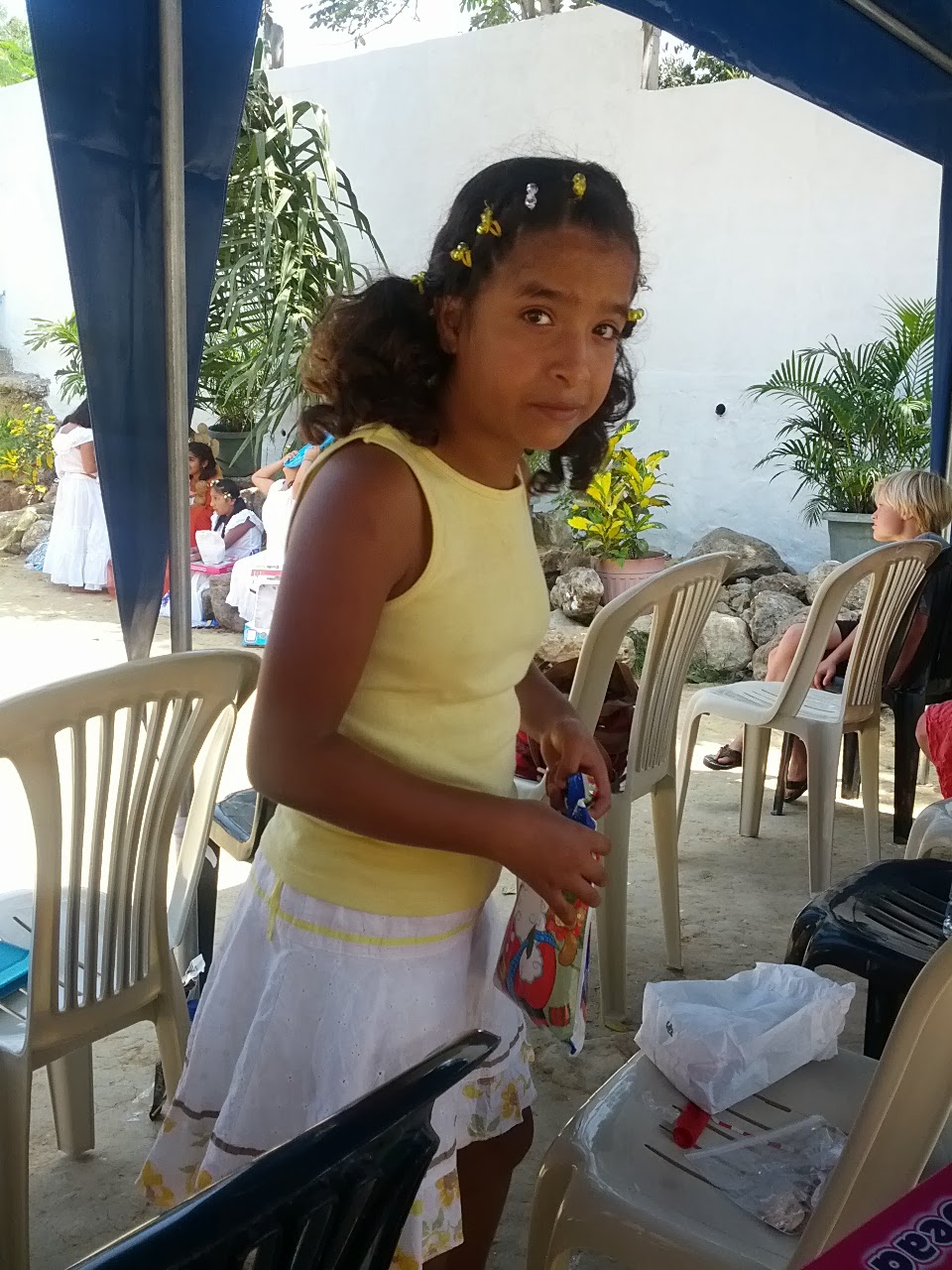
I also learned about the backgrounds of two of the children.  The girl in the previous picture, Rosa Maria, was found alone on the streets of Montañita when she was four or five and has lived there for the past seven years:


She is a sweet girl but is very guarded.  She sat with Emily during the Nativity performance and wrapped herself around Emily's arm once she felt that she could trust her.  After she received her gift from Papa Noel, she said the only words that I could understand: "Mio! Mio! (Mine! Mine!)".  She seemed to warm up to Emily and I (especially Emily) and let us protect her things for her.  The orphanage is taking great care of her.

The second child's story is even sadder.  I never learned his name, so I'll call him "Jared" (that was the name on the back of his shirt):


Jared was found when he was five or six; he had been kept on a leash in his parent's back yard.  He had a wound in his forehead when he was found, and it's unclear whether it was a birth defect or had been inflicted.  (Children with birth defects are sometimes shunned in Ecuador because it is thought that it reflects negatively on the parents.)

He was socially reclusive when he arrived at the orphanage but has learned to accept other people and make friends here; he is making great strides in learning.  He does have difficulty speaking, but he does know how to communicate!  Once he got his soccer ball from Pap Noel, he made it quite clear that he wanted the other boys to go play a game with him.  This is their soccer field:


(That's Jared under the blue awning; the soccer field is the concrete area on the same level.)

Merry Christmas, everyone!