Sunday, January 26, 2014

Tenemos agua caliente! Dia feliz!

We have hot water!  A new water heater was installed and we now have running hot water to the shower and kitchen sink.

A little context is in order first.  Although people in the States take items like hot water, insulation and air conditioning for granted, most houses built in Ecuador do not have these.  For rural Ecuadorians, a house is basically a shelter from the wind and rain and a place to call home.  Houses that Gringos live in are generally either built from scratch or retrofitted to include the "creature comforts" that we're used to having.

If you've read my earlier blog entries, you're familiar with the electric "suicide shower" head that creates hot water for showers.  I turned it on last week to take a shower and it suddenly had a bright orange glow inside.  Not wanting to tempt fate, I turned off the breaker to the shower head and continued with a cool shower.  (The wiring to the shower head was impeccable; the shower head itself had failed.)  I told our hosts about it, and they immediately decided that installing a water heater was in order.

This is where the retrofitting comes in.  This is the layout of the first floor of our casita:


(Please forgive the crudity of the drawing.  MS Word is the only decent drawing tool that I have at the moment.)

The goal was to bring hot water to the kitchen sink (the dual ovals at the bottom) and the shower (that explosion-looking icon in the middle).  With the water heater mounted on the side of the house next to the utility closet, here is how the water lines would run:


The water heater is an on-demand, gas-fueled unit, so it doesn't require electrical service; batteries provide the ignition, there is no tank for storing hot water and a propane tank provides the gas.  It does require venting, however, so it will be installed outside under one of the eaves.

First step: run the water lines.  Running the pipes around the exterior was easy enough:

(water line to the shower)


(water line to the kitchen)


The interior required much more effort, especially for the shower.  The stairs were removed (two lag screws - no biggie), the old shower faucet was chiseled out and a channel for the new pipe was chiseled in:


The new faucet was installed with a little creativity to keep the hot on the right faucet:


All of the connections were made.  Time to mud it back up and reinstall the stairs.  Once it's painted, you'll never know it was there:


Last step - connect the water heater:


Sorry - one more step.  We need new faucets, the kind that have two handles on them:


The whole process took about two days, and we couldn't be happier with the results.  Oh, happy day indeed!

Thursday, January 16, 2014

Driving in Ecuador

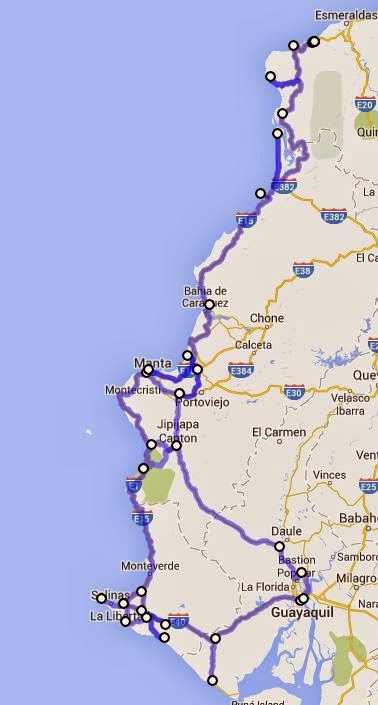
In the course of looking at properties in Ecuador, we have driven over 7500 km in the last 3+ months.  As best as I can represent with Google Maps, here are the places that we've been:


(By the way, all units are metric here. For reference, 100 km is about 62 miles standard/imperial.)

Driving 7500 km (4700 miles) might not seem like much in that time span.  Considering that the northern most point on the map (Atacames) and the southern most (Playas) are about 600 km apart, it adds up to a lot of road trips.

The roads here can hold a lot of surprises, and I recommend driving here only for people with experience and good driving skills.  In addition to having taken formal driving classes on accident avoidance and adverse road conditions (and having grown up in the snow and ice of the Upper Midwest!), I've logged over 500,000 miles of experience.  Here are some of the road trips that I've made in the States:


(I've also received tips and pointers from my brother, a formally trained Highway Patrol officer.  Thanks, bro!)

Driving with a partner is very beneficial.  While I focus on the road, Emily handles all of the navigation, climate and entertainment aspects of our ride.  We use a Garmin for navigation (Emily is a Garmin wizard!) and download podcasts of sports-talk radio shows for entertainment.  (Emily also checks for traffic coming towards the passenger side of our vehicle; in the videos, you might hear her say, "Clear", at times.)


Also helpful in navigating around smaller towns are evacuation maps.  Every coastal city has a map showing the evacuation routes and meeting points in case of tsunami:


The Roads

Thanks to massive infrastructure improvements, the main roads here are very good.  Most of the coastal roads are two lanes (even if they do have an "interstate" designation) with shoulders and curbs.  Here's a YouTube look at the drive from our place to Patacon Pisa'o, our favorite restaurant in Puerto Lopez (42 minutes):

http://www.youtube.com/watch?v=IQXB7-NxhJY

Some of the less traveled roads, however, can be a challenge.  This is our drive from Galera to San Francisco.  The sign looked promising:


The road starts out paved and leveled, but it slowly deteriorates to a two-rut track.  If nothing else, check out the "rustic" suspension bridge at the 46:30 mark (55 minutes):

http://www.youtube.com/watch?v=XvzTInav1Bo

Driving in the cities seems to be more of a free-for-all.  Right-of-way should be determined by traffic control but is more frequently determined by the size or type of vehicle.  Here's what I've observed in the right-of-way hierarchy:


  1. Military vehicles
  2. Heavy equipment
  3. Semi trailers
  4. MetroVia buses
  5. Inter-provincial buses
  6. Local buses
  7. Taxis
  8. Passenger cars
  9. Tuk-tuks (tricicletas - I know, this isn't Thailand, but that's what I call them)
  10. Motorcycles
  11. Push carts
  12. Our car
  13. Pedestrians

Here's a clip showing the drive into and through Pedernales.  The first minute or so shows a detour around a bridge being rebuilt before entering the city.  The "Hand of God" shots are actually Emily reaching forward to adjust the Garmin (5 minutes):

http://www.youtube.com/watch?v=a8og8VZZmJE


Obstacles

Besides the condition of the road itself, being aware of what's on the road is critical.  Not only are the roads used to transport people and goods, they are very commonly used for community functions as well.  Some of the obstacles that I've seen that required slowing down, stopping or detouring include:


  • People
  • Dogs
  • Cats
  • Snakes
  • Dogs
  • Horses
  • Mules
  • Cows (all kinds)
  • Goats
  • Pigs
  • Dogs (always dogs!)
  • Chickens
  • Vultures (because, sadly, many of the other animals get hit by cars)
  • A tarantula (no picture - sorry - but it was a six-inch black beauty of a spider!)
  • Construction 
  • Parades
  • Political rallies
  • Tanks and military personnel carriers
  • Birthday parties
  • Marching band practice
  • Heavy machinery


Traffic Control

Many busy intersections will have a "Transito" (traffic officer) stationed at them.  They do occasionally assist with traffic control (when necessary).

We got stopped at a military checkpoint outside of Crucita one day.  We showed them our papers for the vehicle (insurance, SOAT, etc.), but they were mostly interested in the matricula (title) for the vehicle.  They spoke only in Spanish to us for about five minutes (and we tried as best as we could to respond) before one of them stated, "They speak English!".  At that point, the leader of the trio stated, "We're Marines!", and they all stood up straight and proud in their uniforms.  After that, they went back to speaking Spanish for a couple of minutes before sending us on our way.

Along the major highways there are radar guns posted that will tell the driver the speed of the vehicle and flash if the speed exceeds the limit.  These are useful but not always consistent.  Many times, the radar sign will be posted without any speed limit posting; other times, they're just confusing.  Entering Montañita from the north is this short stretch: 50 kph sign, radar sign enforcing 50 kph and another sign immediately following displaying 70 kph:


The highway that we drive most frequently, E15, connects the beach towns along the coast.  When approaching a town, there are sometimes three sets of (very annoying!) rumble strips to warn the driver:

 !

If the strips do not go all of the way across the road, drivers will adjust to have only one side of the car go over the strips: either moving toward the shoulder or aligning the driver's side with the center line.  I've seen this result in games of chicken to see which approaching driver gets to use the clear middle area.  (Ironically, rumble strips have less impact the faster one drives.)

The most effective form of speed control are speed humps:


These require slowing down to 20 kph and everyone obeys them.  Most of them are well marked, but woe to the inattentive driver who discovers an unmarked one the hard way!


Communication

Horns are used very effectively to communicate.  A couple of quick hits will indicate that someone is passing or to say, "Thanks!".  Horns are rarely used to express irritation (unlike in the States where that seems to be their sole purpose).

Flashing one's headlights is done for two reasons:

  • As self-defense: if a bus is passing a car that has moved over to avoid hitting a goat, a quick flash of the lights will warn the bus that they're approaching oncoming traffic.  (Then again, if it's a bus, see the right-of-way hierarchy above.)
  • As a warning: if a single car flashes it's lights, it usually an indication that there is a pack of mules around the next curve.


Driving at night

Don't.  Even if you know the road you're driving, you might not see that black bull standing in the middle of the road until it's too late.  I heard a guy early one morning swerve late to avoid a parked car and he rolled his truck into the cemetery next door to our casita.  Fortunately, both he and his girlfriend were unhurt:


That's enough for this post.  Time to ride off into the sunset...


Thursday, January 2, 2014

Chicken feet

This is a real quick, kiss-and-cry kind of post.

Emily and I (mostly Emily) roasted a store-bought chicken today.  Since it was a shrink-wrapped "Mr. Pollo" chicken, we expected it would be like chickens in the States.  For the most part it was, but there were two differences.

First, the neck was still attached.  Emily pulled and pulled on it thinking it was like a Thanksgiving turkey where the neck is inserted into the upper cavity.  Nope - it was still a part of the chicken.

Second, there was a pouch inside the cavity with the gizzards and other internal parts (just like a turkey).  But there was a surprise I didn't expect to see:


This will make awesome chicken stock!

Tuesday, December 24, 2013

Navidad at the orphanage

One of the ways that Ex-pats try to give back to the people of Ecuador is to host Christmas celebrations for the children.  Many of these kids have very little and struggle to get by; Christmas is one of those times when we (all of us) can celebrate with them and let them know that we care about them.

Before our last trip to the States, I had a request from my friend Jeffrey (just north of Jama).  He knows many of the kids in his town; they walk past his house on the way to school.  He wanted to have a gift for as many of the kids as possibly, so Emily and I went to a thrift store in Florida and loaded up half of a locker with Hot Wheels, Barbie dolls and Transformer trucks.  Used toys didn't cost us that much (about $50), but they are very appreciated by the kids here.

We also have some Hot Wheels for our own give-aways.  Between Christmas and New Years, two kids will stand on opposite sides of the highway with rope between them.  When a car slows down for a speed bump, they'll pull the rope tight to block the road and stop the car.  Once the car stops, they'll come up the window and ask for money or a treat; the Hot Wheels will be great items to give.

Two of the nicest people you'll ever meet, Bob and Roxanne, host a Christmas party at their place in Manglaralto every year.  What started as a small gathering years ago has turned into a massive production; this year, they served over 500 meals and gave gift bags to 375 of the neighborhood children.  You can find their blog entry here:

http://bobnrox.squarespace.com/journal/2013/12/22/the-kids-christmas-party-2013-was-fabulous.html

For the Ex-pats in our area, we held a party at the Saint Lucia orphanage just north of Montañita.  I say "we", but I didn't do much more than contribute financially.  (I'm still the new guy here; I'm learning as I go!)  Much of the work and coordination was done by our friend and fellow former-Minnesotan, Deb - she's in the middle wearing the hat:


The party started by playing Christmas carols and socializing while everyone settled in to watch the show:


First was the enactment of the Nativity story, beginning with the angel telling Maria that she would soon have a son:


Next came Maria and Joseph looking for a room at the inn:


Jesus is born!  The angel goes to the fields to tell the shepherds (Baby Jesus, Maria and Joseph are on the right):


This causes the boys to break out in a festive version of the "Little Drummer Boy".  I love the "Murphy's Irish Stout" drum - shameless product placement, if you ask me:


(I'm joking about the product placement, of course.  These kids get by with what they have.  Notice that they are all barefoot and none of the hats match or hardly fit.)

Following the Nativity enactment were two dance performances.  First, three young girls in their finest white dresses performing a choreographed number:


After this, a line dance by some of the other girls.  This one was, shall we say, not as choreographed (but still a lot of fun!):


After that, the big event - the visit from Papa Noel!  Each child's name was called and they would go forward and receive their gift:


(Yes, that is his real beard!)

Many of the boys received soccer balls, and many of the girls received jewelry sets. All of the gift bags contains treats and balloons:


After that lunch was served to all of the children.  I don't have any pictures because this was for the kids only.

It was a fun time had by all!

(pause)

But many of the children at the orphanage have not had happy lives at all. 

If you do not want to read about the real lives that a couple of these children have lived prior to coming to the orphange, please do not read any further.  These are honest statements about some of these children's experiences!

This was my first visit to the orphanage, and I'll relate what I've learned.  Children come into the orphanage from many different places.  Unless they have a mental or physical disability, I was told that they are allowed to stay only until they're 14.  After that, they're on their own.

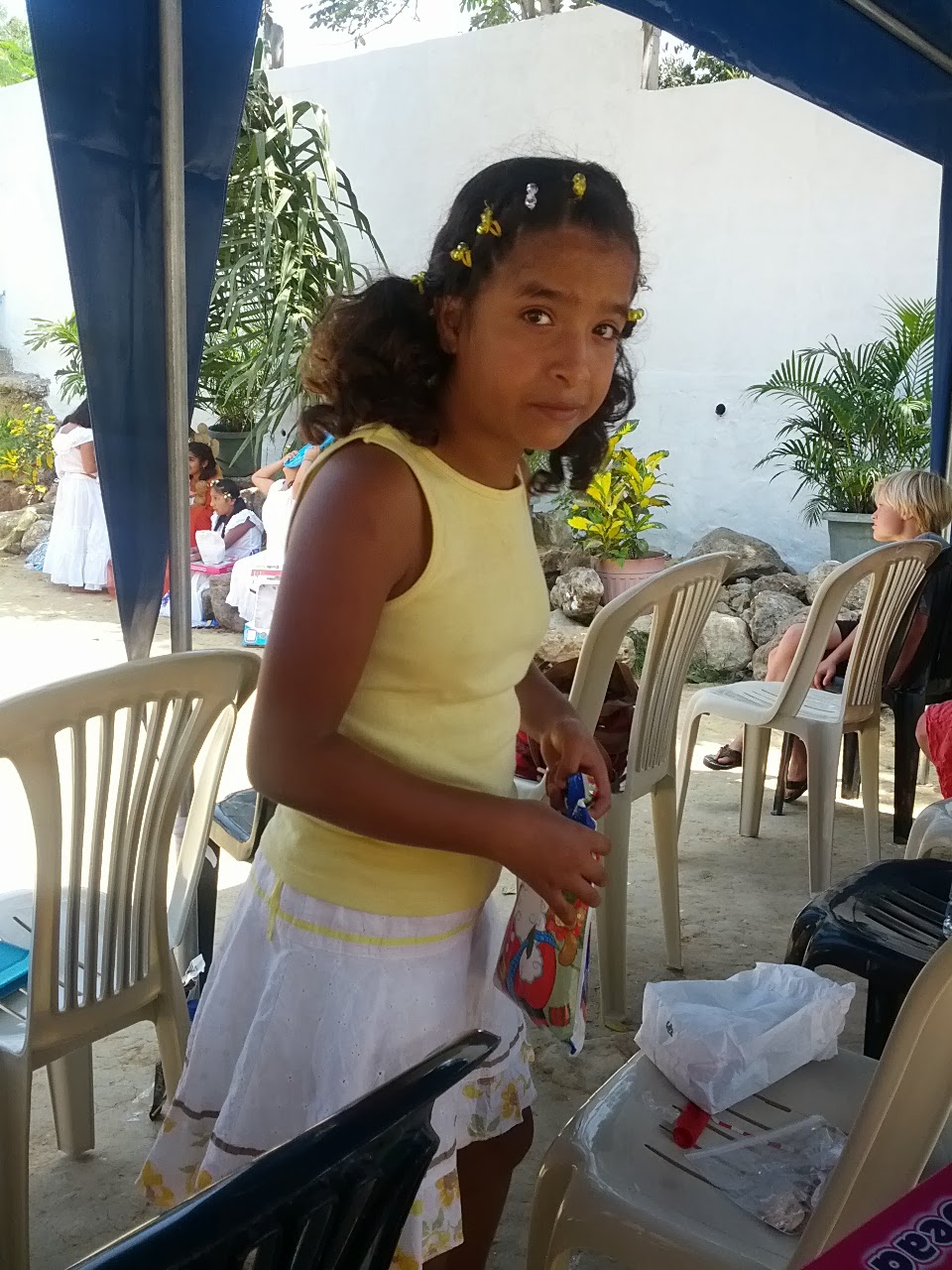
I also learned about the backgrounds of two of the children.  The girl in the previous picture, Rosa Maria, was found alone on the streets of Montañita when she was four or five and has lived there for the past seven years:


She is a sweet girl but is very guarded.  She sat with Emily during the Nativity performance and wrapped herself around Emily's arm once she felt that she could trust her.  After she received her gift from Papa Noel, she said the only words that I could understand: "Mio! Mio! (Mine! Mine!)".  She seemed to warm up to Emily and I (especially Emily) and let us protect her things for her.  The orphanage is taking great care of her.

The second child's story is even sadder.  I never learned his name, so I'll call him "Jared" (that was the name on the back of his shirt):


Jared was found when he was five or six; he had been kept on a leash in his parent's back yard.  He had a wound in his forehead when he was found, and it's unclear whether it was a birth defect or had been inflicted.  (Children with birth defects are sometimes shunned in Ecuador because it is thought that it reflects negatively on the parents.)

He was socially reclusive when he arrived at the orphanage but has learned to accept other people and make friends here; he is making great strides in learning.  He does have difficulty speaking, but he does know how to communicate!  Once he got his soccer ball from Pap Noel, he made it quite clear that he wanted the other boys to go play a game with him.  This is their soccer field:


(That's Jared under the blue awning; the soccer field is the concrete area on the same level.)

Merry Christmas, everyone!


Friday, November 22, 2013

Coming out of the dark

Emily and I returned from our trip to the Esmeraldas province on Friday, November 15th.  We were checking properties further north than we had looked before, and I've got a ton of information that I'll be sharing.  Today is not that day, however.

On Saturday morning, the 16th, we heard a loud "BANG!" and the power immediately went out.  Emily and I (along with the property owners) looked around for the cause of the failure and it appeared to be on the main line running along the highway.  The owners put in a call to the power utility requesting service, but no one was available.

The utility offices are closed on Sunday, so the calls started again on Monday.  With the assistance of our housekeeper (it's best if an Ecuadorian makes these types of calls), we were told that someone would be out to look at the problem.  When?  They didn't know.

At 10:30p, a pickup pulled up next to the utility pole that feeds service to this property.  One of the guys climbed up a ladder (about 25 feet) and found a faulty switch/insulator device.  They had it replaced within an hour, but that didn't solve the problem.  They blamed it on the transformer on the spur line that feeds the houses.  After some discussions and skepticism, it was decided to replace the transformer.

(Why did they wait until Monday night to come out?  One of the line workers told us that Gringos are low on the priority list when it comes to getting service.  If it had been an Ecuadorian house, the utility company likely would have been here on Saturday.)

We were told that the new transformer would arrive on Friday, the 22nd.  In the meantime, Emily and I would load up our computers and phones once each day and head to a local restaurant to recharge and use the WiFi.  A special thanks to Jaibel at Patacon Pisao in Puerto Lopez and the Hotel Montanita (in Montanita, of course) for providing services.

We also adapted to living without electricity.  The stove and oven are gas, so cooking was no problem.  Candles and a kerosene hurricane lamp worked for lights:


The property is on city water, so no pumps are necessary for getting water or using the toilet.  The only drawback: the shower.  Since it's a suicide shower with the electric shower head, we had no hot water for showering.  No fun!  We did get caught up on our Kindle reading, however:


(To be fair, the property owner did have a generator and offered run an extension cord over to our cottage.  I thought it would be good practice to go without, however; infrastructure in Ecuador is still developing in most areas, and we likely won't have power available when we start building our place.)

Thursday night at 9:00p, four guys showed up in a pickup with the new transformer!


Here comes the interesting part: installation.  First, the old one had to be removed.  One of the guys climbed up a ladder (about 30 feet), hooked up a block and tackle pulley and unbolted the old one:


(Sorry about the water spots on the camera lens.)  Once it was down, they hooked up the new one to the same system:


This transformer is filled with oil and weighs about 450 pounds, way to heavy to lift by hand.  Once it was tied up to the pulley, the other end of the rope was tied to the truck through a lateral pulley:


Watch your toes, dude!


A friend of mine was commenting once on his zip-lining adventure.  Being a critical thinker, he looked at the setup and thought, "I wonder how many single points of failure there are in this system".  The same thought occurred to me here: old pulley, a single rope for lifting, knot failure, welded hooks on the transformer, no secondary/safety line, etc.  No problem - that's Ecuador!

Once it was halfway up, the rope was untied so that the pickup could back up and the rope could be reattached:


The guy on the ladder bolted the new unit in place, made the connections and, at 11:00p, the lights came back on!  Thanks guys - drive home safely!


No more excuses for me.  It's time to finish organizing the pictures and notes from our Atacames trip and find our new home!

Friday, November 8, 2013

House Hunters: Episode Two

Back to business.  The last few posts have been fun, but I want to remind everyone of our number one purpose: finding a place of our own in Ecuador.  We have been renting a very nice cottage for the past six weeks, but it's not our final destination.

I need to lay out some of the ground rules for buying property in Ecuador.  Unlike the States, there is no centralized or regulated process.  There is no MLS system for listing properties, and there are no exclusive buyer/broker or seller/broker relationships.  Brokers are not even required; property can be purchased directly from an owner with only a lawyer to ensure that all of the documentation is filed properly.

But it gets even more interesting from there.  First, the Manglaralto White House from my previous post:


 This property falls under a shared-ownership obstacle.  In this case, the property is owned by seven siblings.  One of them is still in Ecuador, but the other six are not here anymore; they live in the US, Norway, South Africa and other locations.  To sell the property, all seven must agree on the terms in writing; not an easy thing to do with this house.

Another obstacle can be an inheritance property.  When one of the original property owners dies (usually the husband - women live much longer here), the rights to the property are split 50/50: half to the surviving spouse and the other half distributed among any children.  To sell a property, all of the owners must agree to the terms.  Trying to buy a property in this situation can be tied up in the courts for years.

An aside: I know a woman who bought a property like this, vacant, and built a house on it.  One of the property owners showed up after all of the improvements had been made and reclaimed it.  She lost her entire six-figure investment.  She had been shown a false deed to the property and had accepted it without doing the necessary background work.

To purchase property, good lawyers are absolutely necessary.  They will not only ensure that the escritura (title) is free and clear, they will also check the previous six owners for any liens against the property.

Speaking of liens, anyone who purchases a property assumes any financial obligations tied to it.  Here are two such instances:

  • One owner left Ecuador and moved to the States after the government placed liens on his business.  Since he was no longer in the country, the liens fell to his property instead.
  • Many residents in Quito and Guayaquil owned property on the coast and used the electric service free of charge.  The electric company had failed to install meters on the property; the juice was coming in free from the electric lines that ran along the highway.  Once the electric company began cracking down and installing meters, the property owners abandoned the lots rather than pay their bill.  Many of these properties are currently for sale, but the back utility costs fall on the new property owners.  (Much different from the States where that cost would be incurred by the individual.)

Perhaps the most tangled web of debts comes from purchasing a previous business.  This is a property that Emily and I call the "Rio Chico Compound":


This lot is in a great location: Rio Chico is just south of Manglaralto and has great fish and vegetable markets.  It also has over 200' of beach front, almost unheard of in the area.  The buildings need some rehab, of course, but this place could become a Pacific front oasis for renovation costs under $30,000.  (Labor costs in Ecuador run about $15/day per worker and materials are relatively cheap.  New facades could be created for very low cost, and even teardown/rebuild prices are low.)

Unfortunately, there is a caveat.  (Of course there is!)  In the second picture, the brown building on the right is a hostel, and the people who run the hostel also live on the property.  (The also operate the little tienda at the front, right side of the property).

If we were to buy this, we would have three options with regards to the employees:
  • We could buy the property and fire the workers.  We would then be responsible for 25% of all income that they had ever earned on the job as severance pay, but we would then own the property free and and clear.  That wouldn't be too popular with the locals and might result in broken windows in the middle of the night.
  • We could require that the current owner fire the employees and incur the severance fee cost before we buy.  Since the owner is currently under financial hardship, this isn't likely to happen.
  • We could buy the property and keep the employess on board to run the hostel.  Do we really want to run a business on our property from the get-go?  Probably not.  They would probably expect continued housing to be included as well.

Another interesting note about this property and how it relates to the realty process.  We had two different brokers show us the property, and here's what they presented:
  • Hector, a broker we know and trust, told us the asking price.  He also mentioned that the workers on the property hadn't been paid in months and the price was very negotiable.
  • A second broker, a slick-talking local who runs a real estate business in Montanita offered the property with a $50,000 increase in price and made no mention of the current obligations that the property held.  He also said that the price was firm and that it would likely sell for much over the asking price.
  • Additionally, we've also recently seen this property for sale on a local website where the asking price is $110,000 over what Hector told us.

I do know people living on the coast here that have successfully purchased property and are very happy with what they have, but many of them have done so without understanding the full legal implications and trust their lawyers to handle all of the paperwork.  Emily and I want to know the property purchase process in as much detail as possible (like with our visa application) so that we don't get caught with any surprises.

Spoiler alert for those you that watch House Hunters, International.  It is an entertaining show to watch, but it's usually packaged together after a sale has been completed.  I've met a couple of the people that have been featured on the show, and they did not have the purchasing experience as it was presented on the show.  Again, it makes for good theater, but it's not that easy!